
Do You Know How And When To Adjust Your Leadership Style For Different Scenarios?
If not, in this short article, Melany Muraour will uncover the How And When To Adjust Your Leadership Style For Different Scenarios.
The Goleman Leadership Styles (or the six emotional leadership styles) are styles that leaders can take to make sure of a healthy working environment. According to the Goleman Leadership Styles model, leaders should have the ability to deal with the changing environment on the work floor.
Here is a basic overview of “Goleman’s 6 Styles of Leadership”
If you really embrace six leadership styles by Goleman framework and learn how to use it, I am sure it will take your leadership capabilities to the next level. So learn and understand when and how to use each style appropriately. His Six leadership Styles are summarised below:
- Visionary Leadership is when a leader inspires others to pursue a long-term vision. A visionary leader can lose short-term focus since all efforts are focused on the vision.
- Coaching Leadership is when a leader coaches team members to develop and improve over time. Coaching leadership builds engagement and focuses on improving employees to become better individuals and professionals in the long term.
- Affiliative Leadership is completely focused on the people and relationships in an organisation. This leads to happy employees but can at the same time lead to poor performance.
- Democratic Leadership is when an empowered team takes full part in the decision-making process. Ideas and suggestions can be brought forward by any team member, and there is a strive for consensus in decision making. Democratic leadership is an effective leadership style but can sometimes be too slow when fast decisions are needed.
- Pacesetting Leadership is when the leader sets an example of high performance, high pace, and high quality. This leadership style can be good to reach short-term results but can be detrimental to employee engagement and motivation in the long run.
- In Commanding Leadership, the leader makes all the decisions. Tight control and high clarity are critical in Commanding leadership, which can be effective in low-skilled teams or when requiring quick decisions.
Switching Up Your Leadership Styles
All the Goleman leadership styles should be used to different proportions depending on the situation. As a rule, pacesetting and commanding leadership should be used sparingly, and the visionary, democratic, affiliative, and coaching styles should be used regularly and in larger proportions.
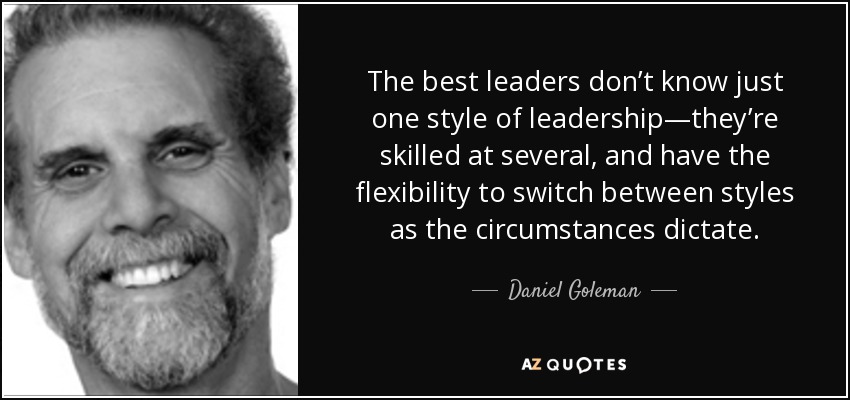
The most important aspect of this framework is that since each style fits a different situation, as a good leader you’ll need to be able to switch styles when the context requires that.
Want to learn more?
“How And When To Adjust Your Leadership Style For Different Scenarios” is just one of five lessons in the E-Cademy “Leadership Essentials” Training Course as shown below:
- Lesson 1: Understanding The Differences Between Leadership And Management
- Lesson 2: Adjusting Your Leadership Style For Different ScenariosLesson
- 3: Managing Difficult Conversations With Your TeamLesson
- 4: Motivating Individuals Within Your TeamLesson
- 5: Using Coaching To Rally Team Performance
To view the E-Cademy “Leadership Essentials” Training Course Overview, click here
Want to know why this E-Cademy Course is for you?
You save TIME
E-Cademy takes a no-nonsense, no-fluff approach and aims to “train you in a day.”
You save MONEY
E-Cademy courses have premium content BUT they don’t come with a premium price tag. Their courses are priced to offer you value-for-money
You save EFFORT
E-Cademy does all the research and work in putting together interesting and appropriate content so you don’t have to scour the web to get the information all over the place. They do it all for you and make it convenient for you to get what you need within a few lessons!
Ready… Set… GO? Start this E-Cademy Course now – just click here